
A Timeless Journey Through Tradition and Modern Life
Between Gyeongbokgung Palace and Changdeokgung Palace,
nestled in the quiet hills of central Seoul, lies Bukchon Hanok Village.
More than just a tourist attraction, this place is a living museum of Korean heritage —
a neighborhood where the rhythms of daily life flow gently through centuries-old lanes.
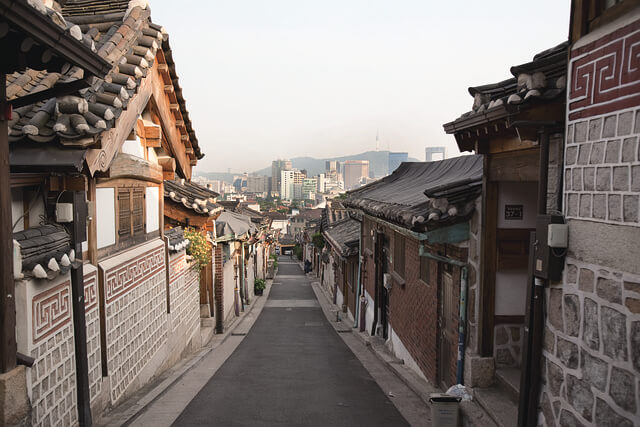
Here, tiled rooftops curve gracefully under the sky,
stone walls guide your steps,
and every turn of the alley whispers stories from the Joseon Dynasty.
A Village Born Beside the Palaces
The name Bukchon means “northern village,”
because it lies north of Cheonggyecheon Stream and Jongno,
the heart of old Seoul during the Joseon Dynasty.
Home to royal families and high-ranking officials,
Bukchon was once the most prestigious residential area in the capital.
Surrounded by Gyeongbokgung, Changdeokgung, and Changgyeonggung Palaces,
it served as the neighborhood of kings — literally “the village beside the throne.”
Though Seoul has transformed over centuries,
Bukchon remains one of the few places where the elegance of the Joseon era still lives on,
its hanok houses preserved in harmony with the modern city around them.
The Charm of Bukchon: Walking Through Layers of Time
1. The Beauty of Hanok – Harmony Between Nature and Space
Over 900 hanok (traditional Korean houses) line Bukchon’s narrow alleys.
Each roof tile, wooden door, and curved eave
embodies the Korean philosophy of balance, simplicity, and natural harmony.
A hanok is designed to breathe —
to let sunlight, wind, and seasons flow gently through its rooms.
To walk through Bukchon is not just to admire architecture,
but to experience a way of life that embraces the rhythm of nature.
2. The Eight Scenic Views of Bukchon (Bukchon 8 Views)
Bukchon’s essence can be captured through its eight iconic viewpoints:
- Gahoe-dong 31 Alley – A perfect photo spot overlooking hanok roofs and Namsan Tower.
- Wonso-dong Craft Street – Home to master artisans of pottery, metalwork, and hanji paper.
- Gahoe-dong Alleyway – Quiet lanes lined with traditional walls and curving rooftops.
- Samcheong-dong Overlook – The best panoramic view of Bukchon’s tiled sea of roofs.
- Jaedong Elementary Road – A peaceful street shaded by ancient trees and stone walls.
- Bukchon Cultural Center Area – A place to learn about hanok structure and daily traditions.
- Gahoeheon & Cheongsongdang Houses – Restored noble residences from the late Joseon era.
- Changdeokgung Stone Wall Road – A serene walkway connecting Bukchon to the royal palace.
Each view captures a different mood of Seoul’s past,
from noble elegance to quiet nostalgia.

Experiencing Korean Tradition in Bukchon
1. Hanbok Experience – Step Into History
To truly feel the spirit of Bukchon, try wearing a hanbok, the Korean traditional dress.
Rental shops throughout the village offer beautiful designs for both men and women.
Walking through the alleys in hanbok turns you into a time traveler —
every photo feels like a scene from a historical drama.
2. Craft Workshops – Art You Can Touch
Bukchon is also a village of artisans.
Visitors can join workshops in pottery, paper crafts, lacquerware, embroidery, and knot making.
Each workshop is run by local masters preserving generations of skills.
Take home your handmade souvenir — a piece of living Korean culture.
3. Bukchon Cultural Center – A Gateway to the Past
Located in a beautifully preserved hanok,
the Bukchon Cultural Center offers exhibits, models, and hands-on programs
that explain the history and architecture of traditional Korean homes.
It’s an ideal stop for travelers who want to understand not only what they see,
but the stories behind every curve and beam of Bukchon’s hanoks.
Nearby Attractions – A Perfect One-Day Cultural Loop
Bukchon is at the heart of Seoul’s cultural district,
surrounded by must-visit neighborhoods that blend tradition and creativity:
- Samcheong-dong Café Street – Lined with art galleries and cozy coffee shops.
- Insadong Street – The best place for traditional tea, crafts, and souvenirs.
- Gyeongbokgung & Changdeokgung Palaces – Majestic royal palaces just steps away.
- National Museum of Modern and Contemporary Art (MMCA) – Where history meets modern art.
Together, these places form Seoul’s “Golden Cultural Route”,
a journey through past and present in a single stroll.

Respecting the Spirit of the Village
Bukchon is still a living neighborhood, not just a heritage site.
Families have called these hanoks home for generations.
As a visitor, a few small courtesies help preserve its peace:
- Be mindful when taking photos near private homes.
- Keep voices low while walking through residential alleys.
- Don’t litter — respect the calm and cleanliness of the community.
These simple gestures allow the charm of Bukchon to remain timeless.
The Seasons of Bukchon – A Living Painting
- Spring: Blossoms bloom between tiled roofs, and soft sunlight fills the alleys.
- Summer: Green vines and potted plants bring life to wooden gates.
- Autumn: Golden gingko leaves turn the streets into a shimmering canvas.
- Winter: Snow rests gently on rooftops, and warm lanterns glow behind paper windows.
No matter the season, Bukchon always feels alive —
a quiet world apart from the city, yet deeply woven into its heart.
Travel Information
- Address: 37 Gyedong-gil, Jongno-gu, Seoul, South Korea
- Subway: Anguk Station (Line 3), Exit 2 — 5 minutes on foot
- Hours: Open year-round (some residential areas have restricted access)
- Best Time to Visit: 9:00–11:00 AM for soft light and fewer crowds
- Nearby Cafés: Samcheong-dong, Gahoe-dong, and Jeongdok Library area
- Seoul Hanok Site
The Meaning of Bukchon
Bukchon Hanok Village is not a frozen relic — it is a living heritage.
It shows how tradition can coexist with the present,
and how history continues to breathe in everyday life.
Sunlight over curved tiles,
the scent of pine from an old gate,
the echo of footsteps on a stone path —
each moment here feels like touching time itself.
Bukchon is not just a village to visit,
but a story to walk through.
To walk Bukchon is to walk through time.
Between tradition and modernity,
you’ll find the quiet heartbeat of Seoul still echoing in every stone alley.